How To Get To The Falkland Islands In 2026: Every Route Compared
Two scheduled flights a week, one military airbridge, and a cruise season that brings in more people than every aircraft combined.
Short answer
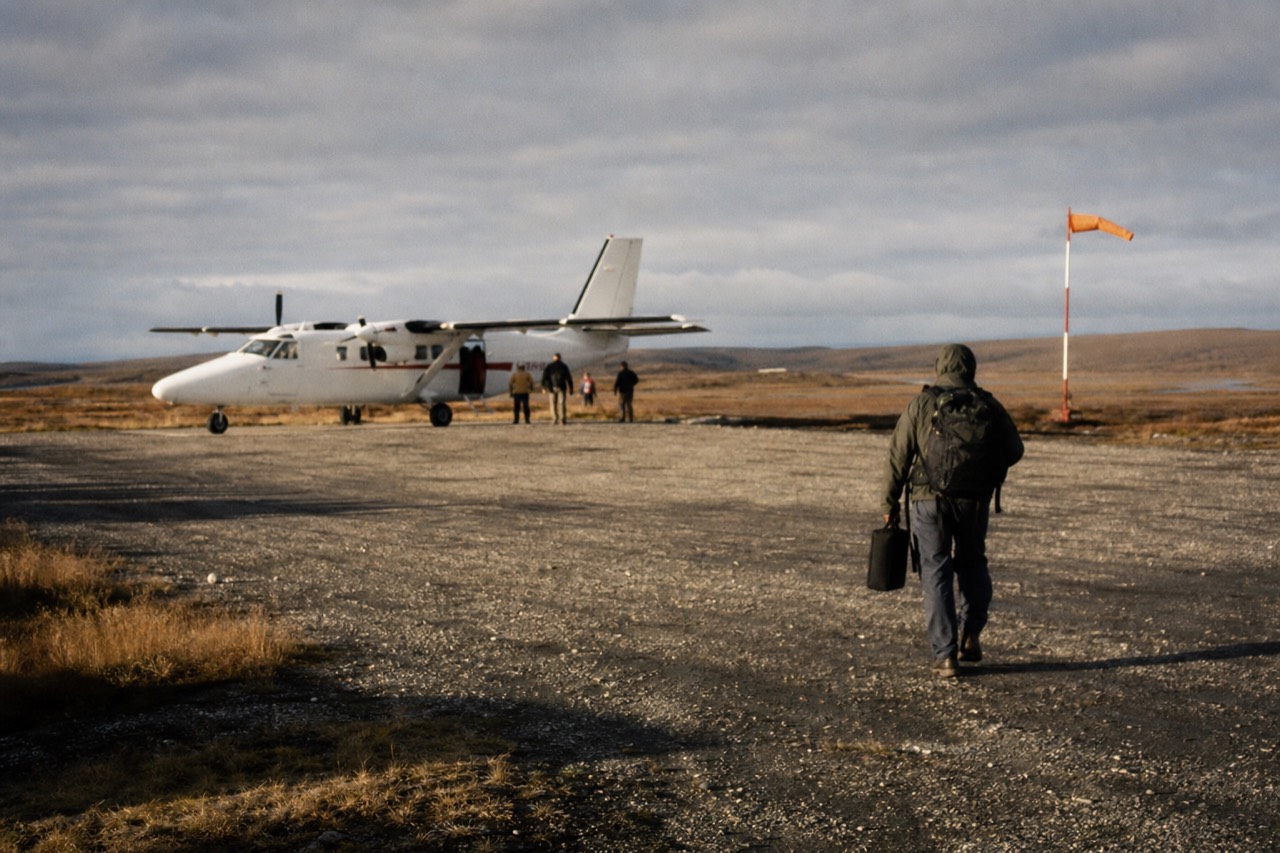
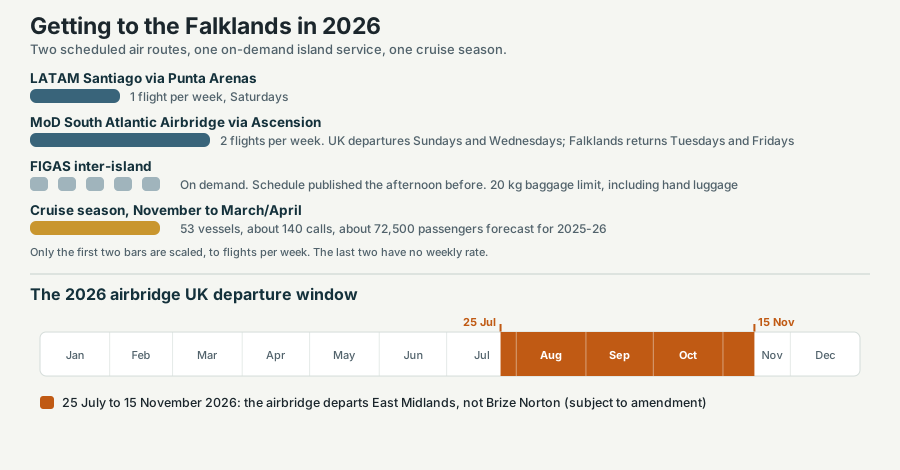
There are three ways in. LATAM flies Santiago to Mount Pleasant every Saturday, stopping at Punta Arenas each way and Rio Gallegos once a month. The UK airbridge runs twice weekly via Ascension, temporarily departing East Midlands rather than Brize Norton from 25 July to 15 November 2026. Most visitors arrive by cruise ship. No visa is needed: a month's permission is granted on arrival.
There is no back door into the Falkland Islands. Look at a chart of the South Atlantic and the nearest neighbour with an airport is 300 miles of grey water away. Everything that lands here does so on purpose, on a fixed day of the week, and if you miss it you wait. That constraint shapes a trip more than anything else: not the weather, not the cost, but the fact that departures are counted in flights per week rather than flights per day.
The good news is that the routes themselves are simple. There are three, plus one internal network that gets you between the islands once you arrive. The big change for 2026 is a temporary UK terminal switch, and it catches out anyone working from an older guide.
What Are The Only Ways To Reach The Falkland Islands?
Three routes serve the islands. LATAM flies from Santiago via Punta Arenas every Saturday. The UK Ministry of Defence airbridge runs twice weekly via Ascension Island, with civilian seats sold through its London office. Cruise ships bring the largest share of visitors, with about 140 calls forecast this season.
Each route suits a different traveler. The LATAM flight is the one most South America itineraries use: it slots onto the end of a Patagonia trip and lands you at Mount Pleasant early in the afternoon. The airbridge is the practical choice from the UK, though it is a military service carrying civilian passengers rather than a normal airline. The cruise ships are the reason the islands see tens of thousands of visitors against a resident population of a few thousand.
The numbers are lopsided in a way that surprises people. Air arrivals run to a few thousand a year across all purposes. Cruise arrivals for the 2025-26 season are forecast at roughly 72,500 passengers across 53 vessels. If you meet another visitor in Stanley in January, the odds are heavily that they came in on a tender rather than a plane.

| Route | From | Frequency | Best for |
|---|---|---|---|
| LATAM scheduled flight | Santiago, via Punta Arenas | Every Saturday, year-round | South America itineraries, land-based stays |
| MoD South Atlantic Airbridge | UK, via Ascension Island | Twice weekly, departures Sundays and Wednesdays | UK travelers, longer independent trips |
| Cruise ship | Ushuaia, Punta Arenas, South Georgia, Antarctic and South American itineraries | Roughly 140 calls forecast this season | The large majority of visitors, a single day ashore |
| FIGAS (once you are there) | Stanley, to the outer islands | On demand, schedule published the afternoon before | Reaching Sea Lion Island, Carcass, Saunders and the rest |
How Does The LATAM Flight From Santiago Work?
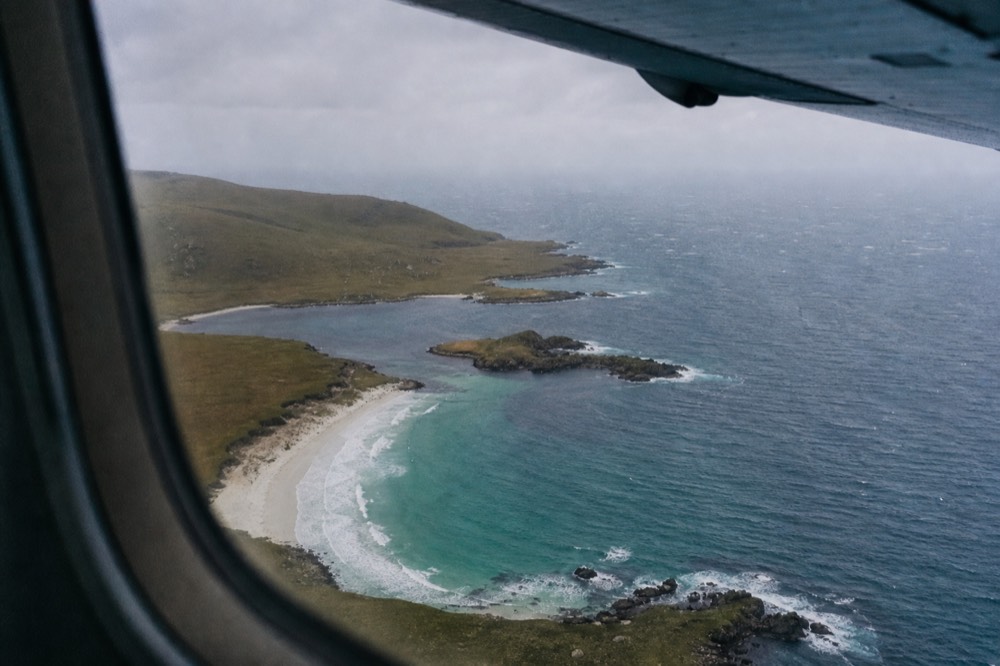
LATAM operates Santiago to Mount Pleasant every Saturday year-round, with a stop at Punta Arenas in each direction for Chilean customs. Once a month the flight also calls at Rio Gallegos in Argentina. A typical August 2026 pattern had the Punta Arenas leg leaving around 11:20 and arriving Mount Pleasant around 12:59.
This is the route that turns a Falklands trip into a normal piece of travel planning rather than an expedition. You fly to Santiago on any of the usual long-haul carriers, connect onto the Saturday service, and you are on the islands by early afternoon the same day. Coming back works the same way in reverse, which means the natural land-based stay is a multiple of seven days.
That weekly rhythm is the thing to internalise. There is no Tuesday flight to catch if plans change. A missed connection in Santiago does not cost you an afternoon, it costs you a week, so most travelers build a night in Chile before the Saturday departure rather than trusting a same-day connection. The tourist board's own getting here page carries the current timings, and they do shift.
The monthly Rio Gallegos stop matters mainly for Argentine-side itineraries. It is not an every-week option, so if it is part of your plan you need to check which Saturday in the month carries it before booking anything else.
| Element | Detail |
|---|---|
| Operating day | Every Saturday, year-round |
| Origin | Santiago (SCL) |
| Intermediate stop | Punta Arenas (PUQ), each way, for Chilean customs |
| Occasional stop | Rio Gallegos (RGL), once a month |
| Destination | Mount Pleasant (MPN) |
| Example timing (August 2026) | Departs Punta Arenas around 11:20, arrives Mount Pleasant around 12:59 |
| Planning implication | Land-based stays run in seven-day blocks |
How Does The UK Airbridge Work In 2026?
The South Atlantic Airbridge runs twice a week via Ascension Island, with civilian seats bookable through the Falkland Islands Government Office in London. UK departures are Sundays and Wednesdays; returns from the islands are Tuesdays and Fridays. From 25 July to 15 November 2026 it departs East Midlands Airport rather than Brize Norton.
This is the detail that trips up anyone reading an older article. RAF Brize Norton is resurfacing its runway, so for that window every passenger airbridge flight to and from the Falklands uses East Midlands instead. The change was announced by the Falkland Islands Government in June 2026 and is stated as subject to amendment, with the first affected northbound flight falling at the end of July. If you booked before the announcement, your ticket may still name the old terminal.
During the East Midlands period the expected pattern is a Sunday departure from East Midlands at 2100, arriving Mount Pleasant at 1255 on Monday, with the return leaving Mount Pleasant at 1045 on Tuesday. Those are the published expectations rather than a guarantee, and the government's own East Midlands FAQs page is the place to confirm before you commit to hotels either end.
Two practical notes on the airbridge in general. It is a military service, so the passenger experience, the baggage rules and the check-in windows follow military rather than commercial airline conventions. And the routing through Ascension makes the total journey long by any standard, so most people who use it are staying for weeks rather than days.
| Standard arrangement | 25 July to 15 November 2026 | |
|---|---|---|
| UK terminal | RAF Brize Norton | East Midlands Airport |
| Reason | Normal operation | Brize Norton runway resurfacing |
| Frequency | Twice weekly | Twice weekly |
| UK departure days | Sundays and Wednesdays | Sundays and Wednesdays |
| Falklands departure days | Tuesdays and Fridays | Tuesdays and Fridays |
| Expected outbound timing | Published per flight | Depart East Midlands 2100 Sunday, arrive Mount Pleasant 1255 Monday |
| Expected return timing | Published per flight | Depart Mount Pleasant 1045 Tuesday |
| Staging point | Ascension Island | Ascension Island |
Has The Sao Paulo Route Restarted?
No. The LATAM service from Sao Paulo has not resumed since it was suspended during the pandemic. The tourist board's official page still describes it as a Wednesday flight that should soon be reinstated, but as of August 2026 it remains unavailable and no 2025-26 operations have been confirmed.
The flat answer matters because plenty of older articles still list it as a live option, and booking engines occasionally surface phantom routings. Plan on Santiago.
The practical consequence is that Brazil-based and Europe-via-Brazil itineraries have to route through Chile, adding a domestic or regional leg. If the Wednesday service does return, it would double the scheduled air capacity into the islands and change the shape of a Falklands trip considerably, so it is worth a check on the official page rather than a search engine snippet when you plan.
Until then the count stands at one commercial flight a week from South America and two military flights a week from the UK. Everything else that brings visitors floats.
Is A Cruise The Easiest Way To Reach The Islands?
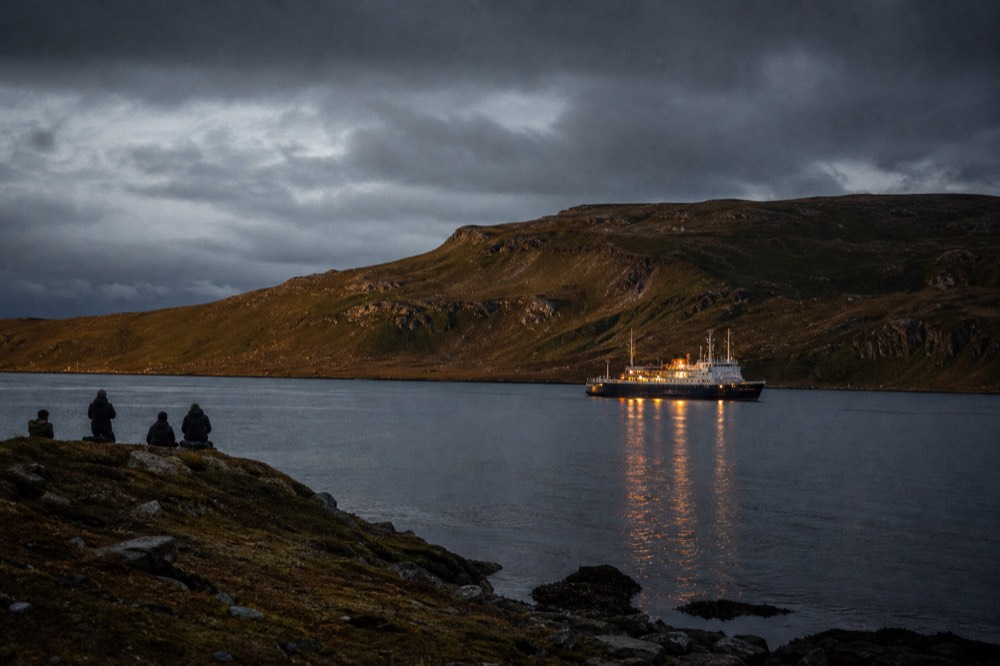
For most people, yes. Cruise ships account for the overwhelming majority of arrivals: 53 vessels and roughly 140 calls are forecast for the 2025-26 season, with around 72,500 passengers. The trade-off is time. A call gives you hours ashore, while a flight gives you days.
The islands sit on the natural line between Ushuaia, South Georgia and the Antarctic Peninsula, and on many South America coastal itineraries, so a Falklands call appears on everything from expedition ships carrying a hundred passengers to large vessels carrying thousands. The season runs November to March or April, with a shoulder in October.
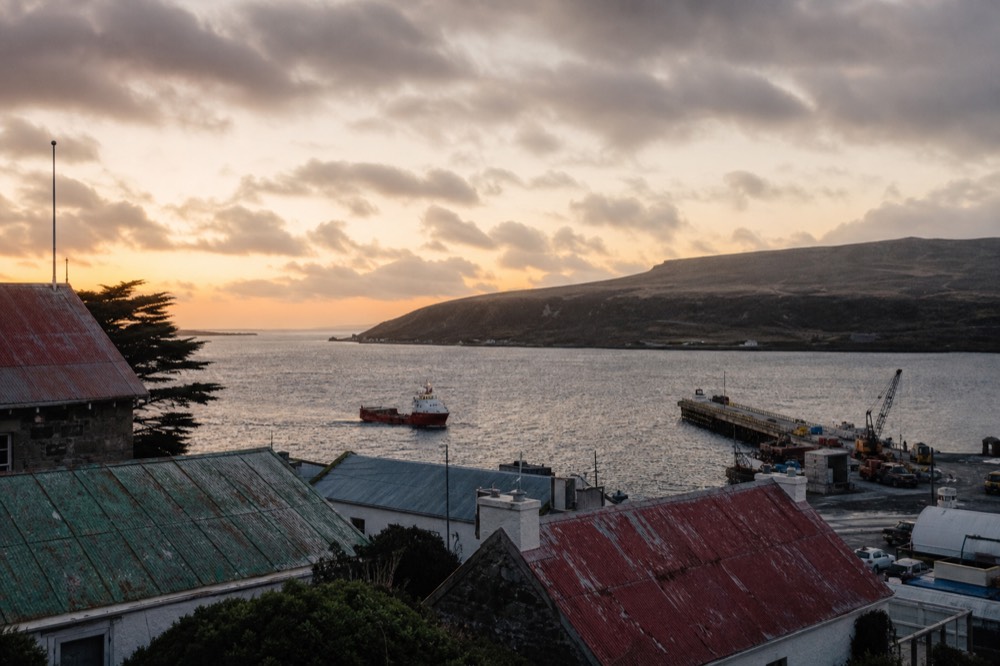
Most ships anchor and run tenders to Stanley's public jetty. Smaller expedition vessels can sometimes berth at FIPASS instead. Either way the practical planning problem shifts from routes to hours, which is a different discipline entirely: the Stanley port-day playbook works through the tender maths and which excursion fits which length of call.
If you are choosing between a cruise call and a land-based stay, be honest about what you want. A day ashore can absolutely include a king penguin colony, a gentoo colony or a battlefield drive. What it cannot include is the outer islands, an unhurried Stanley, or the chance to wait out a bad weather day. Land-based visitors get all three.
| Cruise call | Land-based stay | |
|---|---|---|
| Time on the islands | Hours, set by the ship | Days, usually in seven-day blocks |
| How you arrive | Tender to the public jetty, or alongside at FIPASS | LATAM Saturday flight, or the twice-weekly airbridge |
| Outer islands | Out of reach | Reachable by FIGAS, on-demand schedule |
| Weather flexibility | None; a lost call is lost | A bad day can be swapped for a good one |
| Pickup for tours | Jetty or Tender Landing Stage | Hotel or accommodation pickup |
| Realistic tour count | One | One a day if you want it |
How Do You Fly Between The Islands?
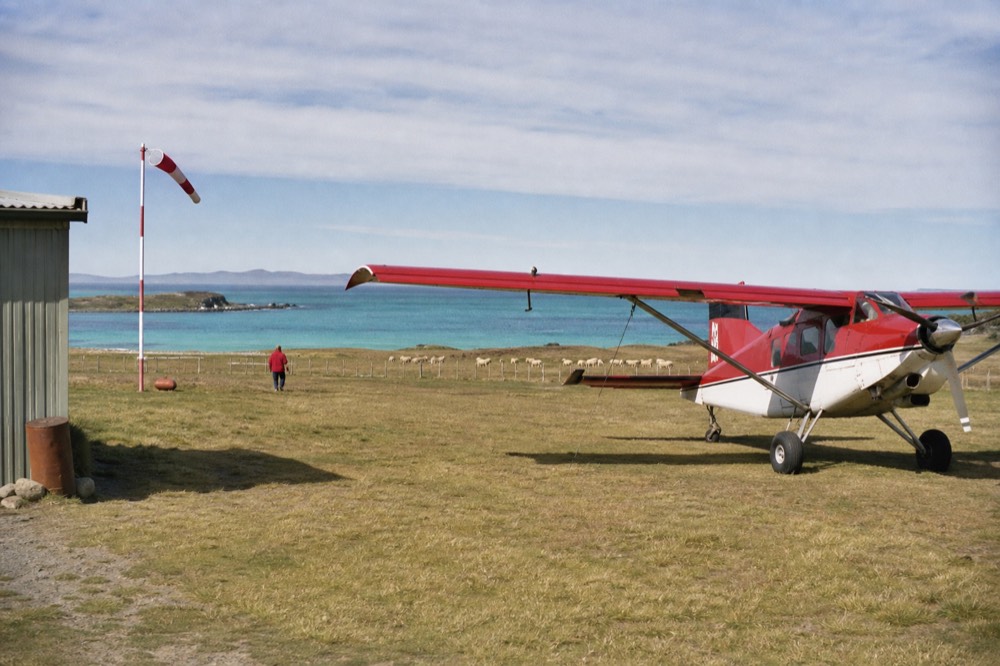
FIGAS, the Falkland Islands Government Air Service, runs Islander aircraft on demand rather than to a fixed timetable. The next day's schedule is published the afternoon before. Visitors get 20 kg of baggage including hand luggage, with excess charged at £1.55 per kilogram per sector. Book by 10am the day before.
This is the part of Falklands travel that feels genuinely different. There is no timetable to book against, because the aircraft go where the passengers are going. You tell the operations desk where you want to be and on which day, and the schedule that emerges is built around everyone's requests. In the afternoon it is published, and you find out what time you are flying.
The 20 kg limit is the constraint that shapes packing for anyone visiting the outer islands. It includes hand luggage, which is stricter than most commercial allowances, and residents get less at 14 kg. Excess is charged per sector at £1.55 per kilogram and should be flagged in advance rather than sprung at the aircraft. Fares vary by route and distance; a non-resident return between Stanley and an outer island can run in the region of £185 on some routes.
Booking goes through the FIGAS operations desk by email or phone, by 10am on the day before you want to fly. Lodges on the outer islands are used to arranging this on guests' behalf, and if you are staying at one it is usually easier to let them coordinate the flights with your accommodation dates.
| FIGAS detail | What it means |
|---|---|
| No fixed schedule | Flights are built from passenger demand each day |
| Schedule published the afternoon before | You confirm your departure time the day prior, not at booking |
| Visitor baggage 20 kg | Includes hand luggage; residents get 14 kg |
| Excess baggage £1.55 per kg per sector | Declare it in advance rather than at the aircraft |
| Example fare | Around £185 non-resident return on some Stanley to outer-island routes |
| Booking cut-off | By 10am the day before, via the operations desk |
Do You Need A Visa For The Falkland Islands?
No visa is required for visitors of any nationality. Permission to stay for one month is granted on arrival, and your passport needs to be valid for the duration of your stay. That is the whole entry requirement, and it applies whether you arrive by air or step off a tender for the day.
The simplicity here is real, and it is worth stating plainly because the islands' political history leads people to expect paperwork that does not exist. The UK Foreign Office sets out the position on its Falkland Islands travel advice pages, along with the practical safety notes that do apply.
Two of those notes matter on arrival day. Mount Pleasant is a working military airfield, and unauthorised photography there is an offence under the Official Secrets Act, so keep the camera packed until you are clear of the base. And although the demining programme was completed in 2020, ordnance from 1982 still occasionally washes up on beaches: the instruction is simple, do not touch it, and call 999.
If you are travelling on a US passport and want the eligibility question answered in isolation, the short piece on whether US citizens can travel to the islands covers it directly.
| Requirement | Position |
|---|---|
| Visa | Not required, all nationalities |
| Permission granted on arrival | One month |
| Passport validity | Valid for the duration of your stay |
| Photography at Mount Pleasant | Unauthorised photography is an Official Secrets Act offence |
| 1982 ordnance | Demining completed 2020; if you find anything, do not touch it, call 999 |
| Cruise passengers | Same position, no separate visa for a day ashore |
What Happens After You Land At Mount Pleasant?
Mount Pleasant is a military airfield well outside Stanley, so arrival day includes a road transfer into the capital. Taxis operate in Stanley, and self-drive four-wheel drives are available from local hire firms. Tour operators serving land-based visitors will collect from your accommodation rather than the jetty.
Getting from the airfield into town is the first logistical step of a land-based trip, and it is worth arranging before you fly rather than after you land. Accommodation in Stanley will normally organise it. Once you are in town, distances collapse: the capital is walkable end to end, and everything a visitor needs sits along or just off the waterfront.
For getting further, there are two options beyond a guided tour. Stanley Cabs and other local operators run taxis, and self-drive four-wheel drive hire is available through firms including Stanley Services, whose vehicles are based on Bypass Road, and Travel Falklands. Self-drive suits confident drivers who are comfortable on gravel and open camp, and it does not suit anyone hoping to reach Volunteer Point without experience of the track.
That is exactly where the private tour options earn their price. Private transport gives your group its own vehicle, but the current Bertha’s Beach & Beyond and Penguin Paradise listings use per-person pricing that varies with party size. Compare the final total for everyone on your date; a headline price is not a flat vehicle quote.

Which Route Should You Choose?
If you are on a South America itinerary, take the Saturday LATAM flight. If you are UK-based and staying for weeks, take the airbridge. If you want the islands as part of a wider Southern Ocean voyage, take the ship and plan the hours ashore carefully. The routes do not really compete: they serve different trips.
The honest framing is that the choice is usually made for you by where you are starting and how long you have. Nobody flies from London to Santiago to catch the Saturday flight when the airbridge exists, and nobody joins an Antarctic expedition cruise purely to see Stanley. What varies is what you do once you are here, and that is where the planning effort pays off.
| If you are | Take | Because |
|---|---|---|
| Finishing a Patagonia or Chile trip | LATAM, Saturdays via Punta Arenas | It connects from Santiago and lands early afternoon |
| Starting from the UK with weeks to spend | The airbridge, Sundays or Wednesdays | Two departures a week, via Ascension, booked through the London office |
| On a South Georgia or Antarctic voyage | The ship's Falklands call | The islands sit on the natural line of the route |
| Building an itinerary through Argentina | LATAM on the monthly Rio Gallegos Saturday | It is the only scheduled link touching Argentine soil |
| Hoping to reach Sea Lion Island or Carcass | Any route in, then FIGAS | Outer islands are served only by the on-demand air service |
| Looking for a second South American gateway | Nothing yet | The Sao Paulo route has not restarted |
A land-based week supports the outer islands, multiple wildlife sites, weather flexibility and unhurried time in the capital. A cruise call supports one excursion done well. Both are worth doing, and the tours themselves overlap more than you might expect: the same operators serve both audiences, with hotel pickup for land-based guests and jetty pickup on ship days. The 2 hour 40 minute shared run, rated 4.7 across 143 reviews, works either way. You can see all nine tours side by side with durations and price bases, or jump straight to the private-vehicle days if you are travelling as a group.
Whichever way you arrive, the two questions that follow are when to come and what it costs. The month-by-month timing guide covers the first, and the 2026 cost breakdown covers the second, including the one-ATM reality that catches out anyone who lands without cash. If you would rather start with what fills the days, the guide to things worth doing beyond the tour vehicle is the place.

Frequently Asked Questions
Can you fly to the Falkland Islands from Argentina?
Not on a dedicated service. The LATAM flight from Santiago stops at Rio Gallegos in Argentina once a month in each direction, which is the only scheduled air link touching Argentine soil. Every other week the routing is Santiago to Punta Arenas to Mount Pleasant. Check which Saturday carries the Rio Gallegos stop before building an itinerary around it.
How often do flights go to the Falkland Islands?
Three scheduled passenger flights a week in total. LATAM operates once weekly on Saturdays from Santiago. The MoD South Atlantic Airbridge operates twice weekly via Ascension, departing the UK on Sundays and Wednesdays and returning from the islands on Tuesdays and Fridays. There is no daily service and no alternative carrier.
Do I need a visa to visit the Falkland Islands?
No. Visitors of all nationalities are granted one month's permission to stay on arrival, with no visa required in advance. Your passport must be valid for the length of your stay. The same position applies to cruise passengers coming ashore for the day. Mount Pleasant is a military airfield, so unauthorised photography there is an offence.
How do you travel between the Falkland Islands?
By FIGAS, the government air service, which flies Islander aircraft on demand rather than to a timetable. The next day's schedule is published the afternoon before. Visitors carry 20 kg including hand luggage, with excess at £1.55 per kilogram per sector. Book through the operations desk by 10am the day before you want to fly.
Is it better to visit the Falklands by cruise or by plane?
A cruise call is easier and cheaper to reach but gives you hours, not days: roughly 140 calls are forecast this season carrying around 72,500 passengers. Flying in supports the outer islands, multiple wildlife sites and weather flexibility, but the weekly LATAM rhythm means land-based stays run in seven-day blocks.
How long does it take to get to the Falkland Islands from the UK?
The airbridge routes via Ascension Island and is a long journey by any standard. During the East Midlands period the expected pattern is a 2100 Sunday departure arriving Mount Pleasant at 1255 on Monday. Most UK travelers using it stay for weeks rather than days, because the service runs only twice a week in each direction.
Your Next Step
Choose Your Falklands Outing
Initial suggestion; use the optional controls to compare your plans.
Match The Outing To Your Plans
These controls compare the listed itineraries, not personal fitness or guaranteed departure availability. Confirm child ages, access needs and ship return arrangements before paying.
Private Bertha’s Beach & Beyond: A private vehicle, Bertha’s Beach entry, snacks and hot drinks. 4–5 hours; private.
Penguins & Stanley Sightseeing: Yorke Bay, Gypsy Cove and Stanley landmarks with a local guide. 2h 40m; shared.
Compare Your Actual Quotes
Use the same currency and comparable inclusions. A private vehicle is not automatically sold at a flat vehicle price; copy the final total for your party from the provider.
No listed outing matches these choices. Adjust or reset them; suitability that needs individual confirmation must be checked with the operator before booking.
Check your travel date before arranging the rest of your visit. A private vehicle, Bertha’s Beach entry, snacks and hot drinks.
Private Bertha’s Beach & Beyond · 4–5 hours
Confirm your pickup and group quote. Hotel pickup is in Stanley, not an airport transfer.
Choose a date to check the published schedule. Availability and final price are confirmed on Viator.